
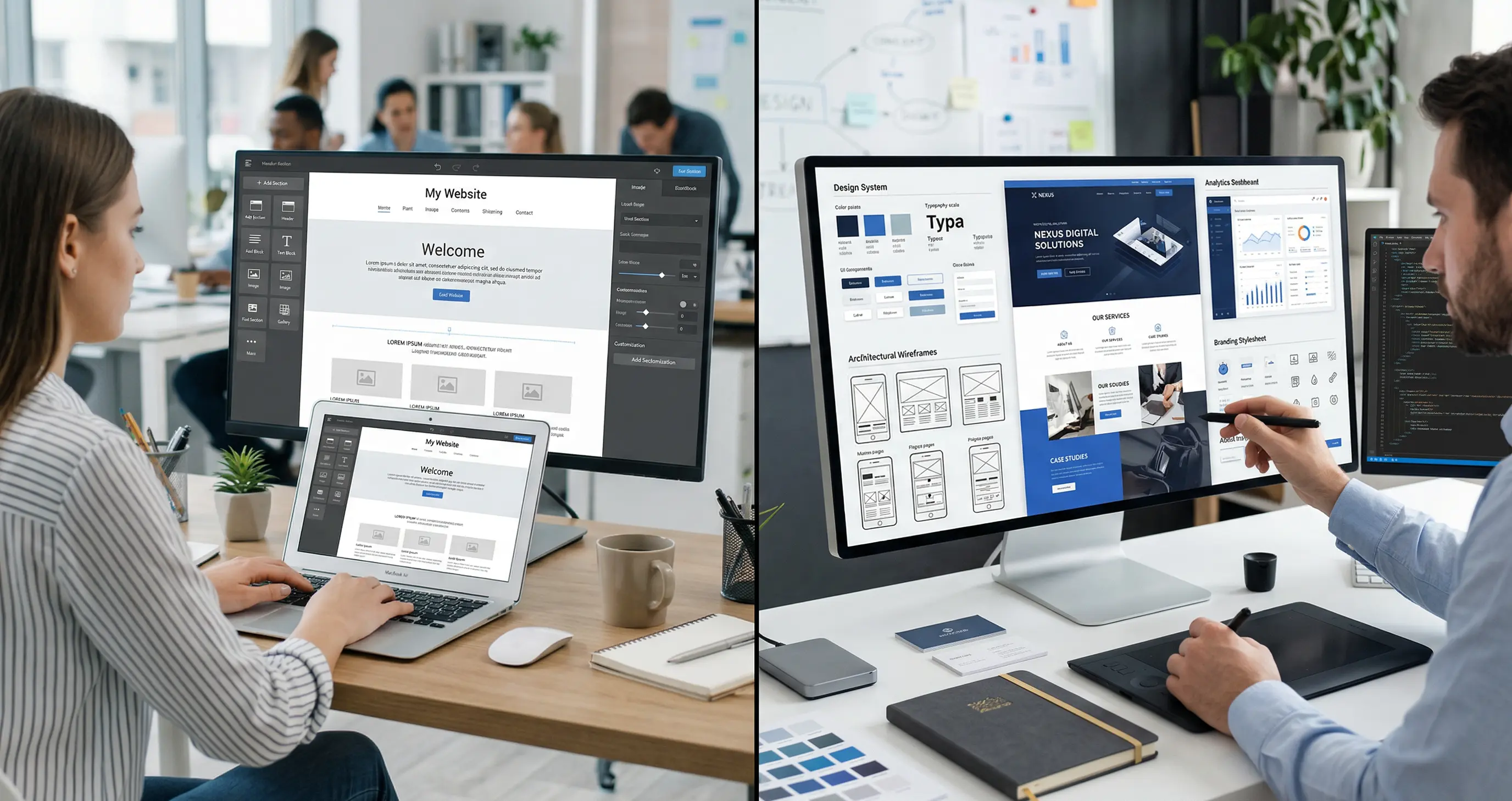
When a business decides it needs a new website, one of the first decisions is often whether to invest in custom web design or go with a template website.
At first glance, template-based platforms can seem appealing. They promise a faster launch, lower upfront cost, and an easy way to get online. For some businesses, that may be enough. But for others, especially those focused on branding, search visibility, performance, and long-term growth, a custom website can be a far better investment.
The truth is that not all websites are created equal. While template-based solutions can work in some situations, they also come with limitations that can affect flexibility, scalability, and how effectively your site supports your business goals.
In this guide, we compare custom web design vs. template websites side by side so you can decide which option makes the most sense for your business, budget, and future plans.
What Is a Template Website?
A template website is built using a pre-designed layout. Instead of creating the design and structure from scratch, you choose an existing framework and customize it with your own logo, images, colors, and text.
Template websites are commonly used on platforms like website builders and content management systems with pre-made themes. They are designed to make launching a site easier and more affordable, especially for businesses that need a basic web presence quickly.
A template website may be a reasonable fit when:
- You need a very simple site
- Your budget is extremely limited
- You need to launch quickly
- You do not need unique functionality
- You are comfortable working within design constraints
The tradeoff is that a template is, by nature, designed for broad use rather than your business specifically.
What Is Custom Web Design?
Custom web design means the website is built around your business rather than the other way around.
Instead of selecting a pre-made layout and adjusting your content to fit it, a custom website is strategically planned and designed based on your brand, your target audience, your goals, and the actions you want users to take.
Custom web design often includes:
- A unique visual design tailored to your brand
- A structure built around your content and customer journey
- Greater flexibility in layout and features
- Better control over user experience
- Stronger technical performance potential
- Cleaner support for long-term growth
A custom website is especially valuable for businesses that want to stand out, generate leads, support SEO, or create a more polished and professional digital presence.
The Biggest Difference: Convenience vs. Strategy
At the core, the difference between a template site and a custom website often comes down to this:
A template website is about convenience.
A custom website is about strategy.
With a template, you are fitting your business into an existing system. With custom web design, the website is shaped around what your business actually needs.
That distinction matters more than many business owners realize. A website is not just something people look at. It affects credibility, conversions, search visibility, and how easily your marketing can evolve over time.
Design Flexibility
One of the clearest advantages of custom web design is flexibility.
Template websites usually come with predetermined page structures, spacing rules, content blocks, and style limitations. You can adjust certain visual details, but there is often a limit to how much you can truly make the site feel unique.
Custom design gives you more freedom to create:
- A distinctive brand presentation
- Better page hierarchy
- More tailored calls to action
- Unique layouts for key pages
- More intentional user flows
If your business operates in a competitive market, looking too similar to countless other websites can work against you. A custom design helps create a stronger first impression and a more memorable brand experience.
Performance and Speed
Website speed matters for both user experience and SEO.
Template websites can sometimes be weighed down by unnecessary code, plugin dependence, or generic theme features that were built to serve many use cases rather than yours specifically. Even when they look polished, they may include extra layers that slow them down.
A custom-built website can often be developed with a leaner, more focused structure. That makes it easier to prioritize:
- Faster page loading
- Better mobile performance
- Cleaner code
- Optimized assets
- Improved user experience
This does not mean every custom website is automatically fast or every template website is automatically slow. But custom development generally provides more control over performance.
SEO Considerations
Search engine optimization is another major area where the difference can become significant.
Many template websites can support basic SEO settings, but they may not be ideal for businesses that want a stronger long-term search strategy. Limitations in code structure, page architecture, content flexibility, and speed can all affect how well a site performs in search.
Custom web design makes it easier to build with SEO in mind from the beginning, including:
- Better heading structure
- Cleaner code output
- Faster performance
- More strategic internal linking
- Custom page layouts for service or location pages
- More flexibility for content expansion
- Better technical SEO implementation
If SEO is a serious part of your growth strategy, a custom site often gives you a stronger foundation.
Scalability and Future Growth
This is one of the most important differences, especially for businesses planning ahead.
A template website may seem perfectly fine when your needs are simple. But what happens when you want to add landing pages, build out SEO content, integrate third-party tools, expand service offerings, or introduce custom functionality later?
At that point, templates often become restrictive.
A custom website is usually better equipped for growth. It can be built with expansion in mind, making it easier to add new sections, new features, more advanced lead-generation tools, or deeper integrations over time.
If your website is likely to evolve along with your business, scalability matters.
Branding and Professional Perception
Your website often forms a first impression before a prospect ever contacts you.
If the design feels generic, crowded, or similar to countless other businesses, that can affect how people perceive your brand. In industries where trust, professionalism, and differentiation matter, that first impression can influence whether a visitor stays or leaves.
Custom web design gives you more control over how your business is presented visually and strategically. That helps support a stronger brand image and a more polished online presence.
For businesses that rely on reputation, premium positioning, or higher-value clients, that difference can be meaningful.
Budget: Upfront Cost vs. Long-Term Value
Template websites usually cost less upfront. That is one of their biggest selling points.
For startups, solo businesses, or organizations with very limited needs, that lower entry cost can make sense. But lower upfront cost does not always mean better value over time.
A template site may eventually require workarounds, redesigns, or a full rebuild once the business outgrows it. That can make the cheaper initial option more expensive in the long run.
Custom web design usually involves a higher upfront investment, but it can deliver more long-term value through:
- Better branding
- Better SEO foundation
- Better lead generation
- Better performance
- More flexibility
- Less need to rebuild later
The right question is not just what costs less today. It is which option better supports your business over time.
Ease of Use
Template websites are often marketed as easier to manage, and in many cases that is true. They are built to be accessible to non-technical users and often provide visual editing tools that make simple updates easier.
Custom websites can also be easy to manage, especially when developed with a user-friendly content management system. But they may require more thoughtful setup on the backend depending on the site’s complexity.
If ease of day-to-day editing is a major priority, that should be part of the planning process no matter which route you choose.
Custom Features and Integrations
If your business needs anything beyond the basics, custom web design usually has a clear advantage.
Examples include:
- Advanced forms
- CRM integrations
- Booking functionality
- Custom databases
- MLS or property feeds
- Dynamic content systems
- Membership features
- Multi-location page structures
- Specialized landing page funnels
Templates can sometimes handle some of these needs through plugins or add-ons, but the more customized your requirements become, the more likely you are to run into limitations or complexity.
A custom website gives you much more control over how features are implemented and how the overall experience works together.
Side-by-Side Comparison
Template Websites
Best for:
- Very small budgets
- Fast launches
- Simple informational sites
- Businesses with limited branding needs
- Short-term or temporary solutions
Advantages:
- Lower upfront cost
- Faster to launch
- Easier starting point
- Often beginner-friendly
Limitations:
- Less unique design
- More structural limitations
- Can be harder to scale
- May rely on bloated themes or plugins
- Less strategic for SEO and conversion optimization
Custom Web Design
Best for:
- Businesses focused on growth
- Brands that want to stand out
- Competitive industries
- SEO-driven websites
- Businesses needing custom functionality
- Companies planning for long-term scalability
Advantages:
- Unique design tailored to your brand
- Better flexibility and scalability
- More control over SEO and performance
- Better support for conversions
- Stronger long-term value
Limitations:
- Higher upfront investment
- Longer planning and build process
- Requires a more strategic approach
Which Option Is Right for Your Business?
A template website may be enough if:
- You need a basic online presence
- Your budget is tight
- You do not need many custom features
- Your site is not central to your growth strategy
- You mainly need something functional and fast
Custom web design is often the better choice if:
- Your website plays an important role in lead generation
- Branding matters in your market
- SEO is a priority
- You need scalability
- You want a site that feels more professional and differentiated
- You expect your marketing needs to grow over time
There is no one-size-fits-all answer. The right option depends on how important your website is to your business and what you need it to do.
Final Thoughts
Choosing between custom web design and a template website is not just a design decision. It is a business decision.
If you only need a basic site to establish a simple online presence, a template may be enough. But if your website is meant to support your brand, attract leads, rank in search, and grow with your business, custom web design often offers a much stronger foundation.
The best website is not necessarily the cheapest or the fastest one to launch. It is the one that aligns with your goals and supports where your business is headed.
A website should do more than exist. It should work for you.
Not sure whether your business needs a template site or a custom website? XomaTech helps businesses choose and build the right solution based on their goals, budget, and growth plans. Contact us to talk through your options.